Why confidence scores matter only in certain decisions
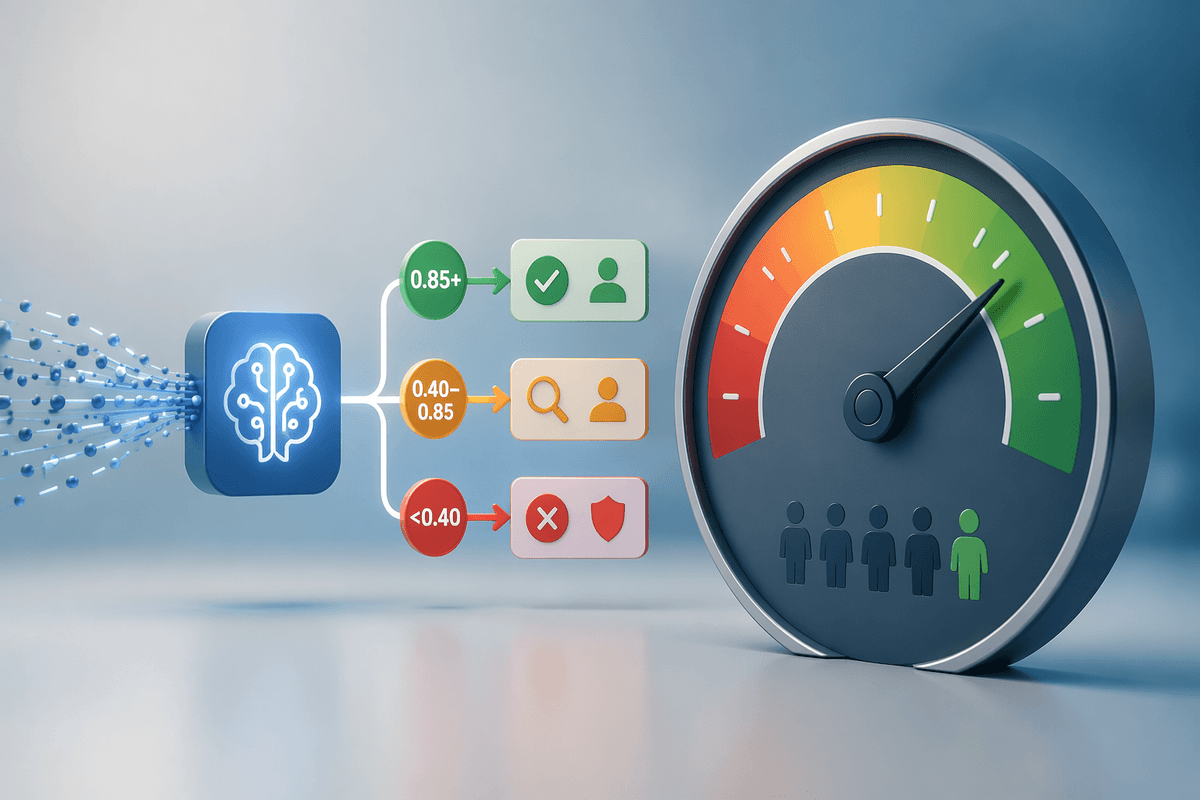
A confidence score only earns its keep when a decision has a clear action tied to “how sure” the model is. If your workflow always sends every prediction to a human, the score is mostly decoration. If your workflow auto-approves low-risk cases, routes borderline cases for review, and blocks high-impact mistakes, the score becomes a control knob.
The catch is that confidence is most useful when you can price the consequences. A false approval might cost dollars, compliance exposure, or customer trust; a false rejection might create churn or support load. Without a real cost model, teams tend to pick thresholds that feel safe, then discover they either review too much (slowing operations) or trust too much (amplifying rare but painful errors).
So the practical test is simple: can you name the decision, the fallback when the model isn’t sure, and the cost of being wrong? If you can’t, start there before debating what the score “means.”
What a model’s confidence score really represents
In most products, a model’s “confidence” is just the number it assigns to its top choice, often shaped by a softmax or similar normalization. That means it’s a ranking signal first: “this option looks better than the alternatives,” not “this is correct with 92% certainty.” Two models can both output 0.92 on the same case and be differently reliable, because the score is influenced by training data, class imbalance, and how the model was optimized.
A useful way to read the score is: “given what this model has seen before, how strong is the evidence for this label versus others?” It says little about whether the input is unusual, whether the label set is missing a plausible option, or whether the case sits outside policy. Those gaps show up later as high-confidence failures unless you validate and calibrate the score against real outcomes.
When high confidence is still wrong: calibration basics
You’ll eventually see the unsettling pattern: a model emits 0.95 confidence, and it’s still wrong in ways your business cares about. That usually happens because the score is not calibrated. Calibration means that, across many predictions, “0.80” should be correct about 80% of the time for the same type of cases. Many models are overconfident, especially on rare classes, edge cases, or when the training objective rewarded separation more than probability accuracy.
Check calibration with a reliability diagram or a simple binning test: group predictions by score ranges (say 0.0–0.1, 0.1–0.2, etc.) and compare predicted confidence to actual hit rate. If 0.9–1.0 predictions only land at 0.7 accuracy, your “high-confidence” automation is riskier than it looks.
Fixes can be lightweight—temperature scaling or isotonic regression on a held-out validation set—but they require clean labels and ongoing rechecks as data shifts. Calibration improves decision-making, not model skill, and it won’t rescue missing classes or policy gaps.
Choosing thresholds that balance risk, cost, and speed
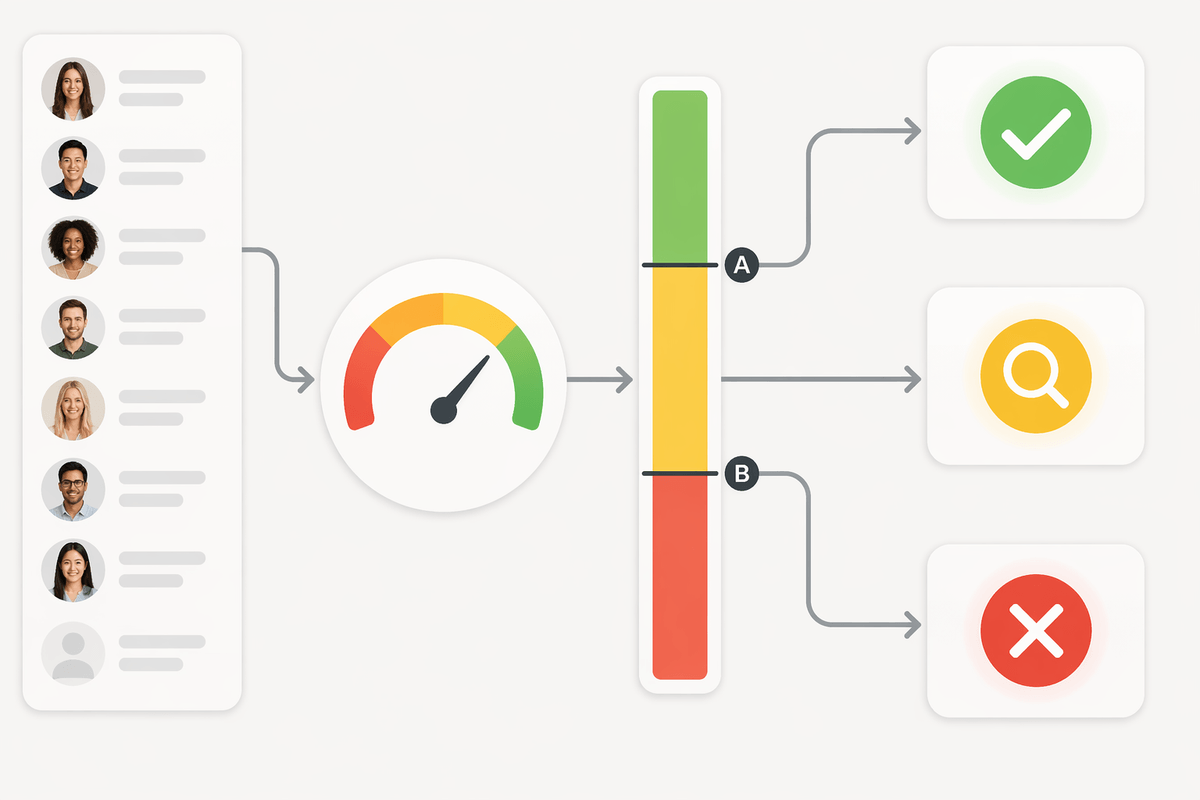
Picture an intake queue where every case has three possible actions: auto-approve, send to review, or auto-reject. A single threshold rarely works because the costs are asymmetric. If a false approval is expensive (fraud loss, compliance breach), you set the auto-approve bar higher than you set the “needs review” bar. The result is usually two cutoffs that create bands: above A, automate; between B and A, route; below B, block or require additional evidence.
Choose A and B by pricing mistakes and labor. Start with a target maximum error rate for automated actions (for example, “no worse than 1 in 200”), then find the score region where measured accuracy meets that bar after calibration. Expect a trade-off: raising A reduces costly errors but increases reviews and slows throughput; lowering B catches more bad cases but raises false rejects and escalations. The practical constraint is data volume—thin score bins make thresholds look stable until they aren’t.
Using confidence to route work to humans effectively
A common failure mode is treating human review as a generic safety net. Routing works better when the model’s confidence drives a specific reviewer task: confirm identity, check policy exceptions, request missing documentation, or override with a coded reason. If reviewers only “rubber-stamp,” you add cost without improving outcomes, and your confidence bands drift because the feedback signal is noisy.
Set up three lanes that match real capacity: (1) auto-handle only the score range that consistently meets your quality bar, (2) send the middle band to humans with clear prompts and limited options, and (3) force review or additional evidence when the score is low or the case is high-impact regardless of score. The practical constraint is staffing variability—when queues spike, teams are tempted to widen automation bands. Build a hard stop for high-risk categories so speed pressures don’t silently rewrite your risk policy.
Turning per-prediction confidence into decision-level reliability
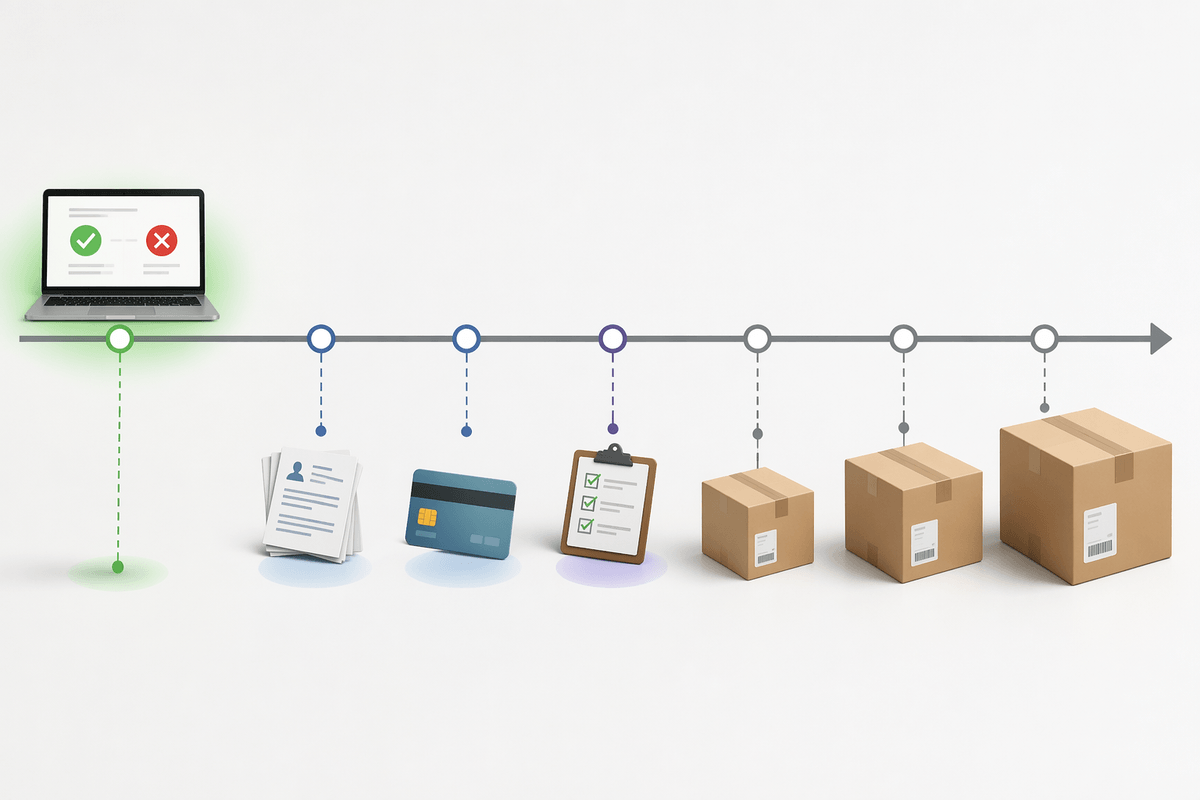
A single prediction’s confidence rarely matches the reliability of the business decision wrapped around it. Decisions usually combine multiple signals: a model score, a rules check, a document match, maybe a user-supplied field. Treat reliability as the chance the whole decision is correct after those gates, not just the model’s top-label probability.
Make this measurable with “decision cohorts.” Track outcome accuracy for each automated path (auto-approve above A, auto-reject below B, exception rules, high-risk overrides), then compute a weighted error rate across the mix you actually ship. This exposes a common issue: a great model band can be undermined by a brittle rule or a weak upstream data field. If ground truth arrives weeks later, you’ll need leading indicators (appeals, chargebacks, audit finds) to avoid flying blind between calibration checks.
Keeping confidence meaningful as data and users change
A month after launch, you’ll notice the score no longer “feels” as safe. The same 0.90 band that met your error bar starts leaking mistakes because inputs shift: seasonality, new products, a policy tweak, or a partner changing how they fill a field. Users shift too. Reviewers learn shortcuts, customers adapt to screening, and your label stream can drift if override codes get messy. Confidence only stays meaningful if you treat it as a monitored metric, not a one-time setting.
Track calibration and automation outcomes by stable slices: channel, region, customer segment, and known edge-case types. Alert on gaps between predicted and observed hit rates inside your automated bands, not just overall accuracy. Recalibration is usually cheap, but it still costs clean labels, time to retrain, and the discipline to freeze thresholds until you’ve revalidated them against fresh outcomes.
A practical rollout plan for confidence-scored decisions
You can roll this out without betting the business on day one. Start by shadow-scoring: log predictions, calibrated scores, and the decision cohort each case would have taken, then compare to outcomes when labels arrive. Use that to set initial accept/review/reject bands with explicit error budgets per action, and lock “never auto” categories (high-impact, low-label volume, known policy exceptions).
Ship automation in a narrow band first, with reviewer prompts that capture override reasons in a structured way. Put weekly checks on band hit-rate versus predicted confidence, plus queue health (review volume, turnaround time). Expect real costs: adding logging, building slice dashboards, and paying for audits or delayed ground truth. Widen bands only after two stable validation windows.