Why traditional routing breaks down in real operations
A route that looks perfect at 4:00 a.m. can fall apart by 9:00. Traditional routing assumes a mostly stable world: travel times behave, stops take roughly the same time, drivers follow the plan, and “constraints” are clean inputs. Real operations aren’t like that. A few late starts, a gate code that’s wrong, a customer who isn’t ready, or a warehouse release that slips by 30 minutes can cascade into missed windows across the day.
Classic solvers are still powerful, but they only optimize what you tell them. When the inputs are averages, stale rules, or incomplete constraints, the output can be a brittle plan that looks efficient on paper and fails on the road. Teams then compensate with manual edits, dispatcher intuition, and driver workarounds—often improving service but quietly adding cost, miles, and overtime.
The practical limitation is that “fixing” this by adding more constraints and buffer time has a price: plans become slower to compute, harder to explain, and less efficient even on good days. Many organizations end up stuck between two bad options—over-optimizing a simplified model or accepting a conservative plan that leaves capacity unused.
The routing constraints that matter before adding any ML
Most routing problems fail for ordinary reasons: you can’t serve what you can’t legally or physically do. Start with constraints that change the shape of the day, not the ones that just tweak minutes. Hard time windows (including promised appointment bands), pickup-and-delivery pairing, depot cutoffs, and driver shift rules are usually non-negotiable. Vehicle and stop compatibility matters too: liftgate requirements, hazmat restrictions, trailer type, access limits, and customer rules like “no box trucks” or “must check in at receiving.”
Then come the constraints that look small until they explode: service-time variability by location, parking and walking time in dense areas, and load/unload sequencing when you can’t dig out a stop’s freight. These are also the ones operators silently handle with workarounds. If your system can’t represent them cleanly—or your data can’t keep them current—adding ML won’t help, and it may simply produce faster wrong answers.
Where machine learning fits versus classic optimization solvers

A common confusion is thinking ML “replaces” the routing solver. In practice, classic optimization still does the heavy lifting of building feasible routes under hard rules like time windows, shift limits, and vehicle compatibility. Machine learning is most valuable where your inputs are uncertain: predicting travel times by time-of-day, service time by customer and stop type, late-start risk by depot, or the likelihood a given plan will miss a promised window.
That division of labor matters because ML outputs are probabilities, not guarantees. If your historical data is thin, biased (only recording what dispatchers allowed), or out of date after a network change, the model can confidently mislead the solver. You may need sustained data cleanup, feedback loops from driver apps, and monitoring to catch drift. Used well, ML makes the solver’s “world model” closer to reality; used carelessly, it just speeds up bad plans.
Better ETA and service-time predictions: the highest-ROI starting point
If you’ve ever had a route “make sense” and still run late, the culprit is usually not the solver—it’s the inputs. The quickest payoff from ML is improving ETA and, especially, service-time estimates at the stop level. Averages like “10 minutes per stop” hide the real drivers of delay: customer type, appointment process, building access, parking, pallet count, signature requirements, and whether the stop is a delivery, pickup, or both. When those times are more accurate, route plans become less brittle, and dispatchers spend less time doing manual triage.
Better predictions change several metrics at once: fewer missed windows, less overtime, fewer unnecessary buffer miles, and more realistic capacity planning. They also help you make cleaner trade-offs—when to add a stop versus protect on-time performance—because the plan’s slack is closer to real slack.
You need consistent arrival/departure timestamps (or driver check-in/out), reason codes for exceptions, and stable customer identifiers. Without that, the model learns your logging habits, not your operation, and the “improved” ETAs will be hard to trust.
Learning from disruptions: re-routing decisions in real time
A dispatcher watching a live board doesn’t need a new “optimal” plan every five minutes; they need a small number of safe interventions when the day breaks. Real-time re-routing is about deciding when to re-optimize, which stops to move, and which constraints must stay locked (appointments, pickups already loaded, driver breaks). ML helps by estimating disruption impact: “If this truck stays on plan, what’s the probability we miss Stop 12’s window?” or “If we swap these two stops, how much overtime risk moves with it?” Those risk scores let the solver search fewer options and avoid constant churn.
Too much re-optimization creates driver confusion, missed handoffs, and customer notifications that keep changing. Many teams set guardrails: only re-route when predicted lateness crosses a threshold, cap the number of stop moves per hour, and require dispatcher approval for changes that affect promised windows. The cost is integration work—streaming GPS, event timestamps, and exception reasons reliably—because real-time decisions degrade fast when the live signals lag or go missing.
Making predictions usable: data, integrations, and guardrails
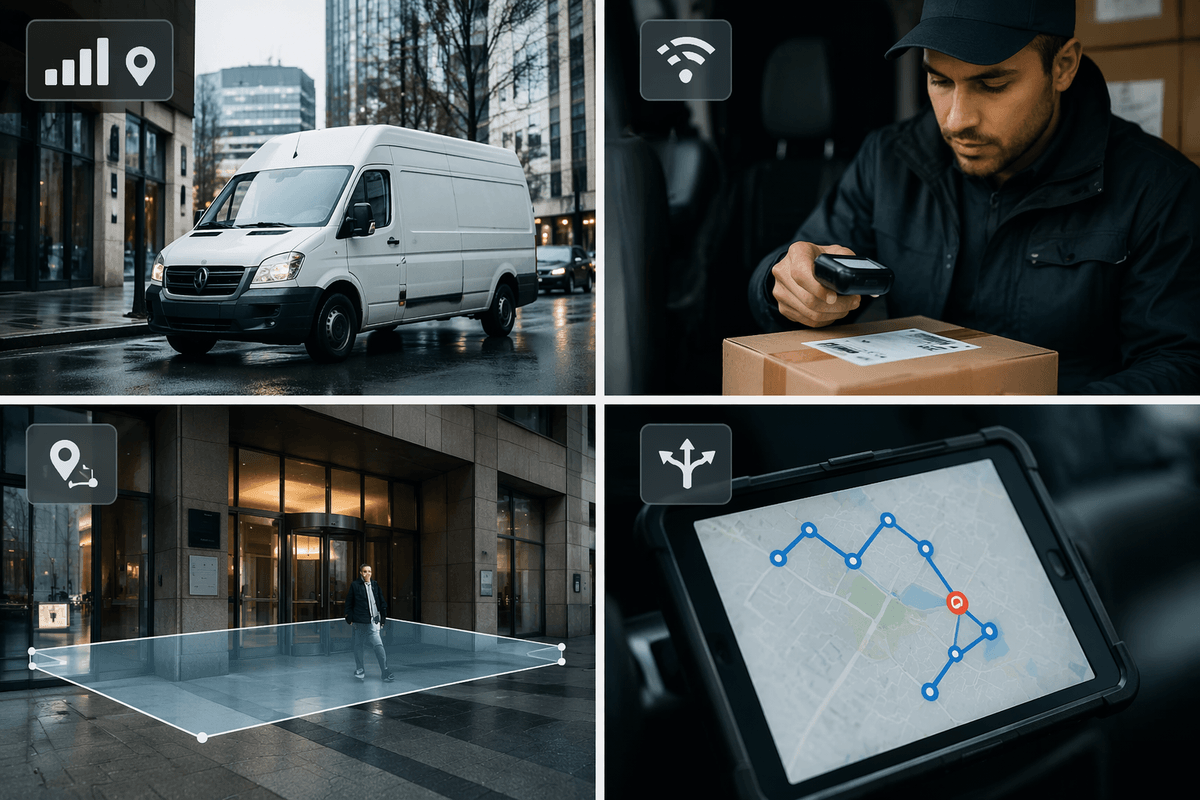
The moment you try to use a prediction inside routing, you run into unglamorous questions: which timestamp is “arrival,” what counts as “service start,” and how often customer rules change without being recorded. Models need clean event definitions, stable stop IDs, and enough context to explain why a stop took 8 minutes yesterday and 35 today. If drivers can’t easily confirm check-in/out, or dispatchers override plans without logging why, the system learns noise and your teams will stop trusting the outputs.
Integration is where most projects slow down. ETAs have to flow into the same places people already work: dispatch boards, driver apps, customer notifications, and billing or timekeeping systems. That means handling late GPS pings, offline scans, and mismatched location geofences. Expect ongoing work, not a one-time build—especially after network changes, new depots, or new service levels.
Guardrails keep predictions from becoming operational whiplash: confidence thresholds, conservative fallbacks, and “no-touch” rules for locked appointments and pickups already loaded. Treat model outputs as advisory unless they pass sanity checks, and monitor drift so a quiet data shift doesn’t turn into a loud service failure.
Measuring success and rolling out without breaking operations
A common failure mode is declaring victory on “miles reduced” while service quietly gets worse. Measure outcomes the business already feels: on-time to promised windows, missed stops, overtime hours, driver plan adherence, customer contacts, and how often dispatchers override the plan. Track prediction quality separately (ETA/service-time error and calibration) so you can tell whether a routing change helped or the inputs just got noisier.
Roll out in slices: one depot, one region, or one stop type, with a control group and a hard rollback switch. Keep guardrails during the pilot—cap route churn, lock appointments, and require approval for high-impact swaps. The real cost is change management: training, exception logging discipline, and weekly reviews to fix data gaps before widening deployment.