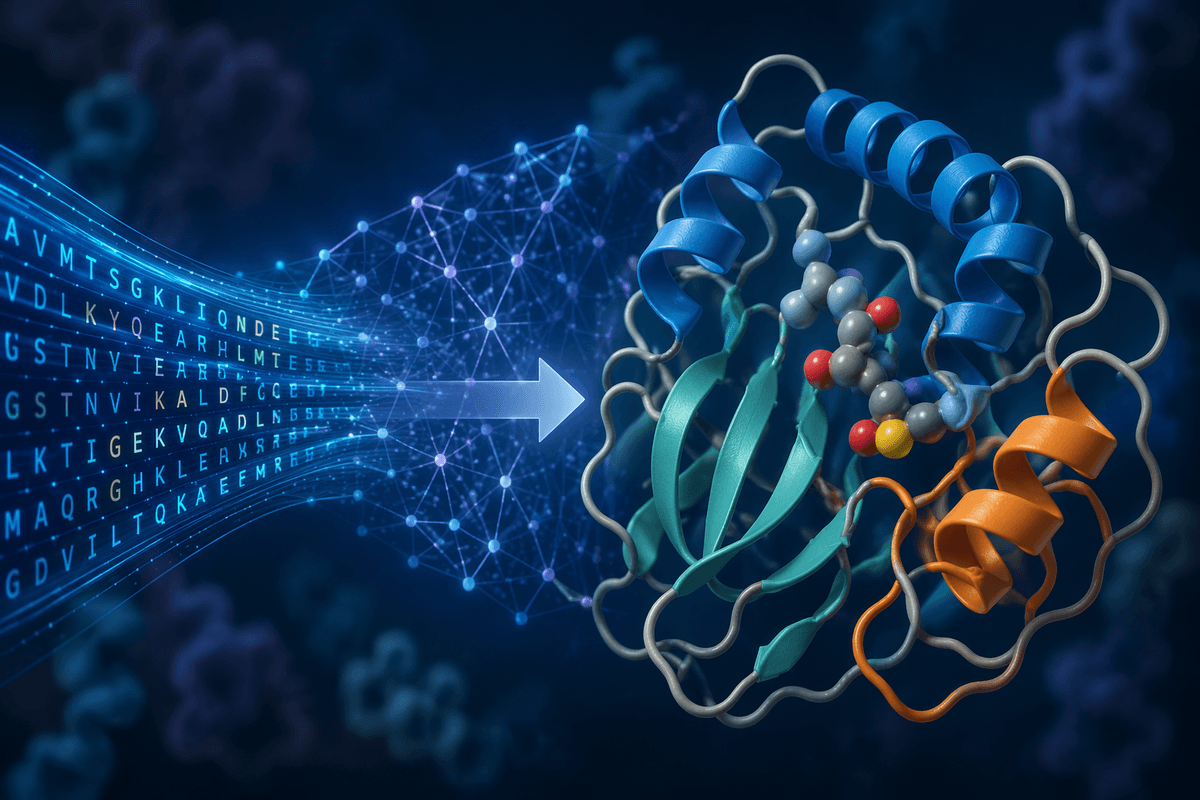
Why protein structure suddenly became a solvable problem
For decades, predicting a protein’s 3D shape from its amino-acid sequence was like trying to fold an unfamiliar piece of origami with only a list of creases. Physics-based simulations were principled but slow and fragile, while “template” methods worked mainly when nature had already solved something similar and deposited it in the Protein Data Bank.
The problem became more solvable when two things aligned: sequence databases ballooned, and machine learning got good at extracting constraints from those sequences. Patterns of co-evolution across millions of related proteins act like indirect measurements of which residues must sit near each other, turning the search from “any fold is possible” into “most folds are ruled out.”
Modern models add scale—GPU-heavy training and networks designed to reason over distances and angles—so they can assemble a consistent geometry rather than a loose contact map. The practical catch is that “solved” often means a strong static guess, not a full account of flexibility, partners, or cellular context.
What older approaches could and couldn’t do reliably
If you were a biologist in the 2000s trying to “predict a structure,” what you got depended heavily on whether your protein had a close cousin with a known fold. Homology (template-based) modeling could be quite dependable for the overall backbone when sequence identity was reasonably high and the domain boundaries were clear. The weak spots were often the parts you cared about most: loops, active-site side chains, and any insertions or deletions that reshape a pocket.
Threading and fold-recognition methods sometimes rescued cases with distant similarity, but they rarely told you when they were confidently right versus plausibly wrong. Ab initio physics-based approaches offered a more general route, yet in practice they were constrained by the size of the search space and imperfect energy functions, tending to work best on small proteins or simplified conditions. Across all of these, multi-domain proteins, conformational changes, and complexes were persistent pain points, and the output often needed heavy experimental triangulation.
The data shift: sequences exploded, structures became training fuel
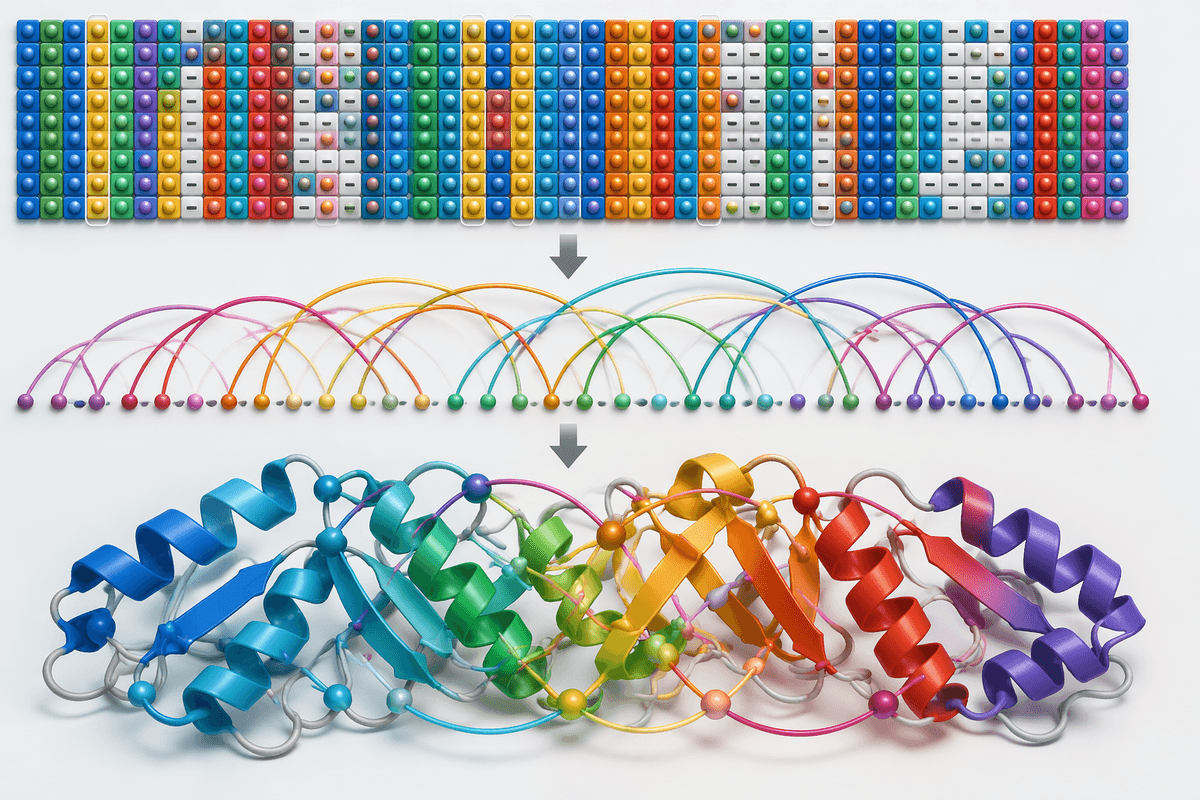
A familiar frustration was having a sequence in hand and no obvious template to borrow. That started to change as sequencing got cheap and routine: UniProt and other resources filled with proteins from microbes, metagenomes, and large-scale projects, creating deep “families” with thousands of related sequences. Those families made co-evolution signals much clearer, because you could see which positions tend to vary together across evolution—strong hints that the residues sit near each other or must move in coordinated ways to preserve function.
At the same time, the number of experimentally solved structures kept growing, turning the Protein Data Bank into a large, standardized set of 3D examples for training and benchmarking. The crucial shift was that sequences weren’t just inputs anymore; they became data that teaches a model what folds and local geometries look like, and what residue-residue patterns usually imply in 3D. The structural labels still reflect what labs can crystallize or image, so some protein classes, flexible regions, and transient states remain underrepresented.
How today’s models turn sequences into 3D geometry
A practical way to picture today’s systems is as constraint-builders and geometry-solvers rolled into one. They start by turning the sequence—and often a multiple sequence alignment of evolutionary relatives—into a rich set of features. Attention-based networks then learn two linked descriptions: what each position “means” in context, and what every pair of positions implies about distances and orientations. That pairwise representation is the bridge from 1D text to 3D shape.
From there, a dedicated structure module assembles atomic coordinates by enforcing a physically plausible geometry: bond lengths and angles stay reasonable, clashes get discouraged, and the whole chain is adjusted to satisfy many local and long-range constraints at once. Many models “recycle” their own output, feeding a draft structure back in to tighten inconsistencies, which is why accuracy often improves over several passes.
The output is also scored. Per-residue confidence and predicted alignment error are the model’s way of saying, “trust this helix, be cautious about that loop.” The deep alignments, large proteins, and multi-chain assemblies can be slower or less stable, and disordered segments may remain genuinely undefined.
The CASP turning point and what “accuracy” really means
People outside structural biology often hear “CASP” as a vague stamp of approval, but it’s closer to a timed exam: predictors model proteins whose experimental structures exist but aren’t yet public, and the results are scored against the later-released ground truth. The turning point was when deep-learning systems started matching experimental-like accuracy for many single-chain targets, especially in the well-ordered core. That mattered because the benchmark is blind and standardized, so improvements couldn’t be explained away as cherry-picking.
“Accurate,” though, is not a single number. A model can place most backbone atoms correctly while still missing a binding-site loop by a few angstroms—enough to change docking outcomes or mutational interpretations. Confidence metrics help, but they’re not guarantees: low-confidence regions often correspond to true disorder or multiple conformations, and the benchmark mostly rewards a single static structure. In practice, accuracy means “good starting geometry,” not “final answer without experiments.”
Where predictions are already changing everyday biology work
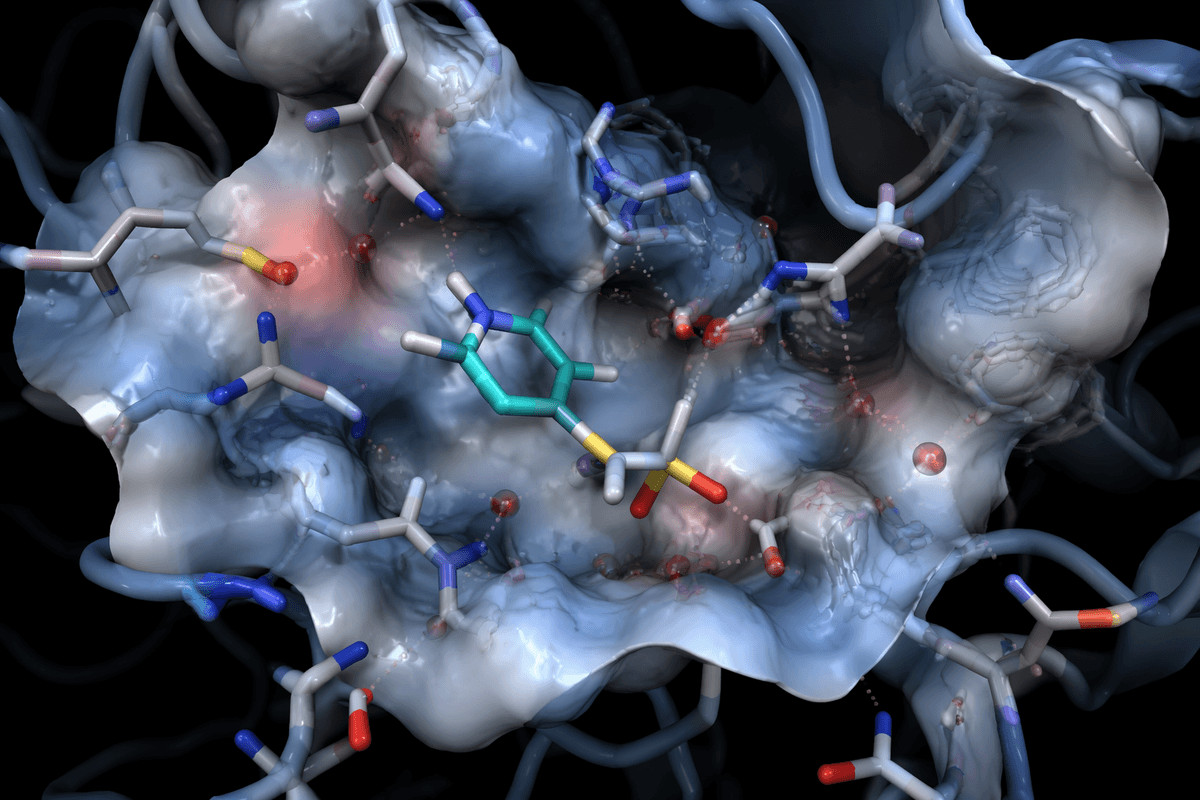
A common everyday moment is having a gene hit from a screen and needing a usable mental model before committing weeks to assays. Structure prediction now often fills that gap: teams use a high-confidence model to identify likely domains, guess where an active site might sit, and decide which constructs to express (for example, trimming long low-confidence tails that tend to behave like disordered regions). It also speeds up “why did this mutation matter?” conversations by mapping variants onto a fold to see whether they cluster in a core, a putative interface, or a pocket.
In protein engineering, predicted backbones make it easier to propose stabilizing mutations, design fusions with reasonable linker lengths, or pick surface residues for solubility and expression tweaks before a full round of wet-lab iteration. Drug discovery groups increasingly use models to frame hypotheses for ligandability or to interpret fragment hits, but they still pay a cost when the details matter: side-chain placement, water networks, induced fit, and alternative conformations can be wrong in exactly the ways that derail docking. The practical pattern is “faster triage and better questions,” not “skip structural validation.”
Where the models still struggle—and what’s coming next
You see the limits quickly when you ask a model for the exact thing a project depends on: a flexible loop that gates activity, a transient interface, or a pocket that only appears after binding. Most predictors still return a single “best” structure, so they underdescribe dynamics, allostery, and condition-dependent states. Complexes are improving, but stoichiometry, weak interactions, membranes, and cofactors (metals, glycans, ligands, waters) can be missing or misplaced, and those details are expensive to validate experimentally.
What’s coming next is less about prettier static backbones and more about usable ensembles and context: integrating sequence with experimental restraints, predicting alternative conformations, and treating binding as a coupled problem rather than an add-on. For practical trust, an operating rule holds: use predictions to narrow hypotheses, then confirm the decision-driving details—interfaces, chemistry, and motion—with targeted experiments or orthogonal computations.