When seconds matter, biased AI can steer choices
A triage nurse sees an “AI risk: low” flag and moves on, an EMS supervisor accepts a suggested closest facility, a dispatcher follows a predicted “non-urgent” code. None of these choices feel unusual in a crowded shift, because the tool is framed as a time-saver, not a policy. The problem is that even small skews—who shows up in the training data, how “severity” was labeled, which outcomes were treated as ground truth—can nudge attention and resources away from certain groups.
Bias here is rarely overt. It shows up as systematic under-triage of patients whose pain is documented differently, misestimated risk when prior access to care shaped the record, or longer response times when neighborhood proxies slip into routing. The practical constraint is that clinicians often cannot audit the model in the moment; they are deciding under time pressure, with limited context, and the recommendation arrives with an implied authority that can quietly override dissent.
The immediate goal isn’t to reject AI, but to treat it like any other clinical input that can be wrong in patterned ways. If a model’s errors fall unevenly—by language, age, disability, ZIP code, or insurance—then “faster” can become “less fair” without anyone intending it. The standard to aim for is simple: decisions should be explainable enough to challenge, and outcomes should be measurable enough to prove the tool is helping more than it harms.
Where bias slips in: data, labels, and workflows

A common failure mode starts long before deployment: the dataset quietly reflects who had access, who stayed in the system, and whose symptoms were documented in detail. ED notes, vitals, and EHR histories can look “complete” while still missing patients who avoid care, arrive by nontraditional pathways, or face language barriers. Even timestamp fields can encode inequity if delays in rooming, imaging, or consults become inputs the model treats as clinical risk.
Labels are another leak. If “true severity” is defined as ICU admission, a procedure, or 72-hour return, the model may learn patterns of utilization and clinician decision-making, not physiology. Under-treatment can become self-justifying: fewer tests and fewer admissions produce labels that imply lower risk, which then reinforces lower testing and admission.
Workflow choices can harden bias into routine. A threshold set for throughput, defaulted order sets, or alerts shown only to certain roles can shift care unevenly—especially when overrides are time-consuming, undocumented, or implicitly discouraged.
High-stakes moments: triage, dispatch, and risk scoring
A patient with chest pain arrives after a long wait, an interpreter is still en route, and the first note is sparse. If the triage model leans heavily on prior diagnoses, “typical” symptom language, or complete medication lists, it can score that patient as lower risk and delay ECGs, labs, or bed placement. The error isn’t random; it tracks documentation patterns and access to longitudinal care.
Dispatch has similar traps. “Closest appropriate unit” and “best destination” models can treat neighborhood, call history, or prior refusals as risk signals, nudging slower responses or different transport decisions for the same presenting complaint. Routing also inherits real constraints—traffic, unit availability, diversion, and staffing—that can make a fair policy hard to implement even when the model is accurate.
Risk scoring at intake or for “frequent use” programs often turns past utilization into future risk. If you rely on these scores, require stratified performance by key groups, clear escalation paths for disagreement, and a record of overrides and outcomes so patterns of under-triage and under-response can be detected early.
Fairness isn’t one thing: choosing what “equal” means
The vendor may say the model is “fair” because overall accuracy is high, but that doesn’t tell you what is being equalized. In emergency settings, you might care about equal sensitivity (missing critical patients at the same rate across groups), equal false-alarm burden (not flooding certain patients or neighborhoods with extra scrutiny), or calibration (a “10% risk” meaning the same thing across groups). Each definition answers a different operational question, and they can conflict.
If baseline risk differs because of access, exposure, or referral patterns, you often can’t make every metric equal at once. Tightening a triage threshold to reduce missed sepsis in one group can increase unnecessary workups in another. In dispatch, shifting resources to equalize response times may worsen coverage elsewhere when units are already thin. These aren’t abstract trade-offs; they show up as longer waits, more tests, and different escalation rates.
The practical move is to pick the fairness target that matches the clinical harm you most want to avoid, then bake it into validation: stratified error reports, threshold-setting by scenario, and documented rationale. Expect added cost—more data work, more meetings, and more clinician time reviewing exceptions—but that’s the price of making “fair” measurable rather than aspirational.
Red flags during procurement and model validation
A familiar procurement scene: the demo looks smooth, the dashboard is clean, and the vendor offers one headline number—“AUC 0.89” or “20% faster triage.” Treat that as a starting point, not reassurance. Red flags include performance reported only in aggregate, subgroup results described as “similar” without showing counts, and validation done on the same health system that supplied the training data. Another warning is when the model relies on variables that are really workflow artifacts (time-to-room, prior visit counts, “compliance” flags), because those can encode inequity and shift when staffing or policies change.
During validation, watch for outcome labels that reflect utilization rather than illness (ICU admission, imaging ordered, discharge destination) and for “ground truth” that varies by clinician, site, or patient communication. Require a local silent trial before go-live, with stratified sensitivity and miss rates by language, age, disability, and payer, plus clear denominators. Budget for the cost: data mapping, clinician review of discordant cases, and renegotiating thresholds when the tool’s errors concentrate in one group.
Designing human-AI teamwork so bias doesn’t become policy
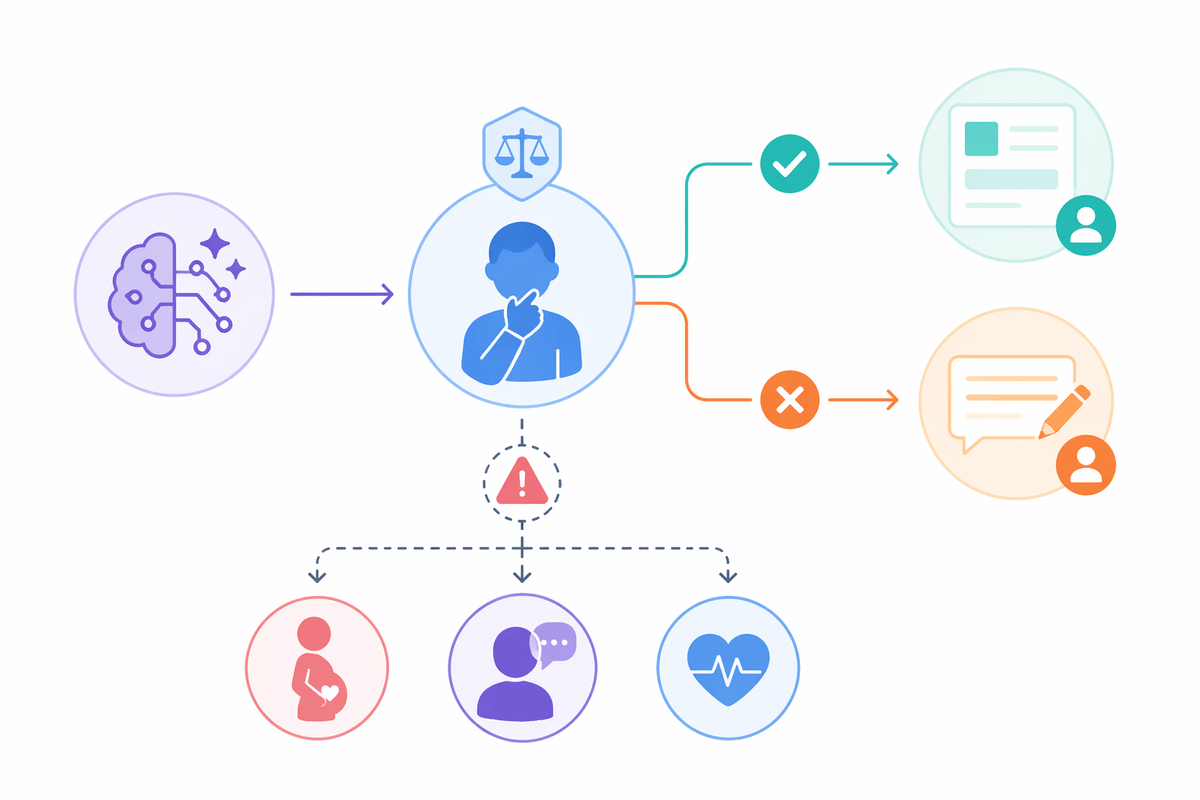
A triage nurse clicks through an alert because the queue is long, not because they agree with it. That is how a recommendation becomes a de facto policy: it is faster to accept than to question. Design the workflow so disagreement is normal and low-friction. Put the model’s key drivers in the same screen as the recommendation (not a separate dashboard), require a brief “reason for accept/override” tap, and define explicit escalation triggers.
Make accountability concrete. Specify who owns threshold changes, who reviews misses, and who can pause the tool after a cluster of harms. Use a two-channel design: the model can suggest actions, but final dispositions require a human confirmation step when the cost of a miss is high. Expect a real operational cost—extra clicks, training time, and periodic case review—but that is what keeps convenience from hardening biased patterns into routine care.
Monitoring in the field: drift, feedback loops, accountability
After go-live, the model you validated is no longer the model you are using. Staffing changes, new triage templates, EHR upgrades, diversion patterns, and seasonal case mix shift the input data, and performance can drift without anyone noticing. Set a monitoring cadence that matches operational risk: weekly checks early, then monthly, with dashboards that show volume, missingness, alert rates, and key outcome rates stratified by language, age, disability, and payer—not just overall AUC.
Watch for feedback loops. If a “low-risk” score reduces testing, the label you later train or evaluate against can become artificially reassuring. Protect against this by sampling and clinician-reviewing discordant cases (low score/high acuity and vice versa), tracking overrides and downstream outcomes, and requiring an incident-style review after clusters of misses.
Accountability has to be explicit: one owner for thresholds, one for monitoring, and a defined “stop button” authority. Budget time for chart review and data work; without it, monitoring becomes performative.
Safer adoption: start small, measure impact, stay transparent
A realistic path is to start with a narrow, reversible use case: run the model silently, or limit it to suggestions that do not change disposition, transport, or priority without a human confirmation. Define success in operational terms before go-live—missed-critical rates, time-to-intervention, response times, and patient-centered harms—then measure them by subgroup with prespecified thresholds for pausing or retuning. Expect friction: data pulls, chart review, and staff time to interpret results are not optional costs.
Transparency is a safety feature. Publish what the tool is allowed to influence, which inputs it uses, where it is known to perform worse, and how overrides are handled and audited. Give clinicians and dispatchers a plain-language “when not to trust this” list, and give leaders a paper trail: version history, threshold change logs, monitoring reports, and incident reviews. If you cannot explain the tool’s role in a bad outcome, it will be treated as unaccountable infrastructure rather than a clinical aid.